
Garnatelier

Free · knitting & crochet · no sign-up

Stripe generator for knitting & crochet

Pick your colours and get a stripe sequence for your blanket, scarf, hat or socks – with row-by-row instructions and how much yarn you need of each colour.

Units
Your project

Your project

Size and yarn decide how many rows you work – the stripes fill exactly that.

Every colour change is on the same side, so you can carry the yarns up the edge instead of cutting.

Colours

Colours

Up to 8. Tap a swatch to change it, or take colours from our yarns.

  • A
  • B
  • C
  • D
Random stripes

Random stripes

Stripe widths and colours are drawn at random – press “New stripes” until you like it.

Counted in steps of 2 rows.

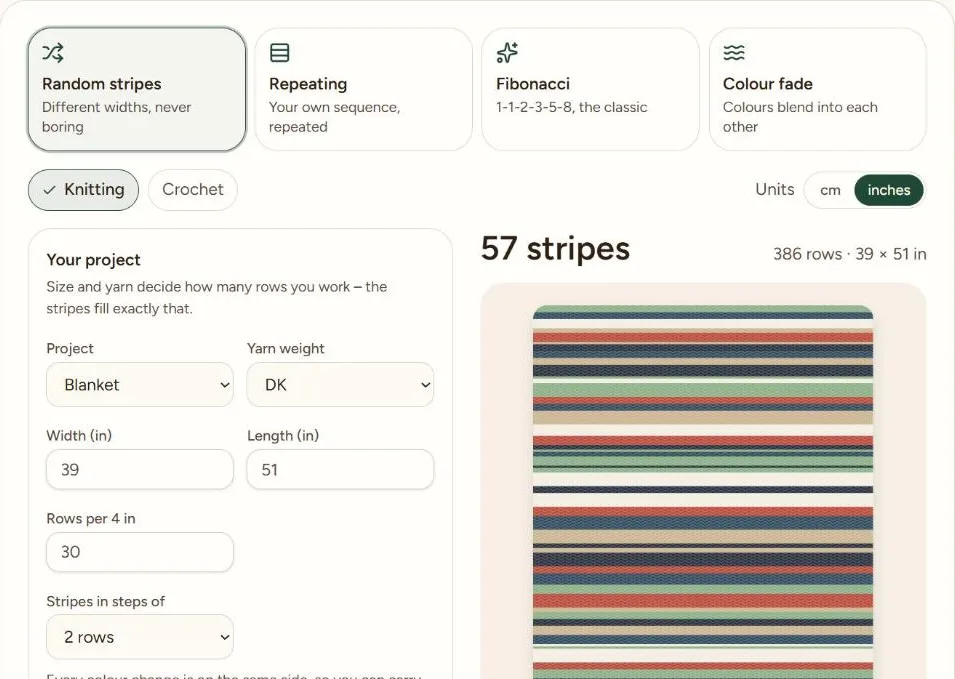
57 stripes

386 rows · 39 × 51 in

4colours
56colour changes
24 ozyarn in total
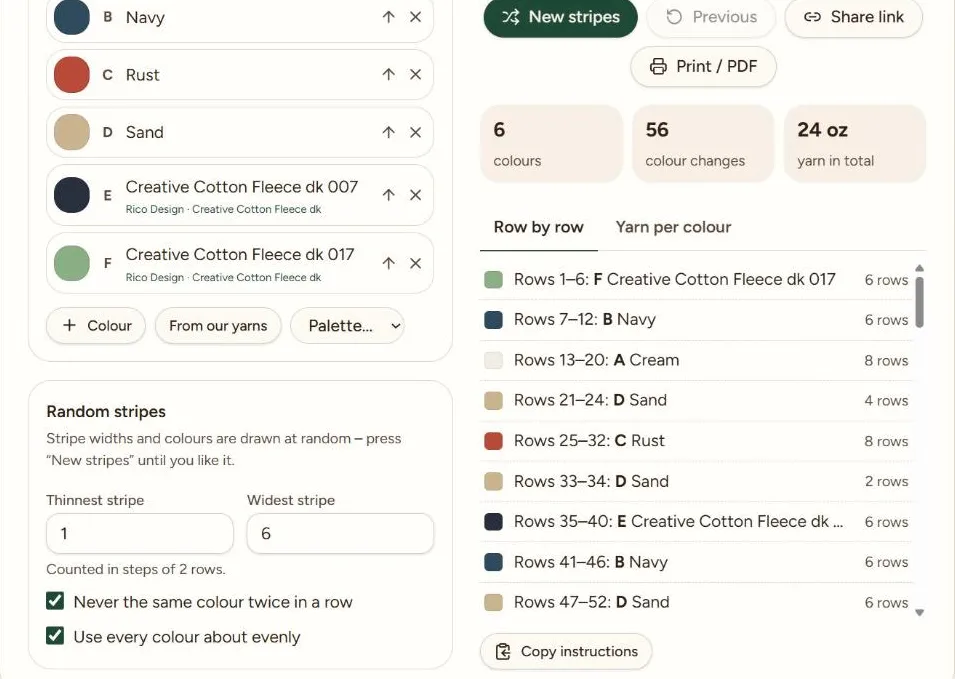
  1. Rows 1–6: D Sand6 rows
  2. Rows 7–12: B Navy6 rows
  3. Rows 13–20: A Cream8 rows
  4. Rows 21–24: C Rust4 rows
  5. Rows 25–32: B Navy8 rows
  6. Rows 33–34: C Rust2 rows
  7. Rows 35–40: D Sand6 rows
  8. Rows 41–46: C Rust6 rows
  9. Rows 47–52: A Cream6 rows
  10. Rows 53–62: C Rust10 rows
  11. Rows 63–64: D Sand2 rows
  12. Rows 65–68: A Cream4 rows
  13. Rows 69–80: D Sand12 rows
  14. Rows 81–86: B Navy6 rows
  15. Rows 87–92: A Cream6 rows
  16. Rows 93–104: B Navy12 rows
  17. Rows 105–114: C Rust10 rows
  18. Rows 115–122: A Cream8 rows
  19. Rows 123–126: D Sand4 rows
  20. Rows 127–128: C Rust2 rows
  21. Rows 129–132: D Sand4 rows
  22. Rows 133–140: C Rust8 rows
  23. Rows 141–142: D Sand2 rows
  24. Rows 143–146: C Rust4 rows
  25. Rows 147–158: A Cream12 rows
  26. Rows 159–164: B Navy6 rows
  27. Rows 165–176: A Cream12 rows
  28. Rows 177–184: D Sand8 rows
  29. Rows 185–196: B Navy12 rows
  30. Rows 197–208: D Sand12 rows
  31. Rows 209–212: C Rust4 rows
  32. Rows 213–216: D Sand4 rows
  33. Rows 217–228: B Navy12 rows
  34. Rows 229–234: C Rust6 rows
  35. Rows 235–244: A Cream10 rows
  36. Rows 245–252: C Rust8 rows
  37. Rows 253–264: D Sand12 rows
  38. Rows 265–268: B Navy4 rows
  39. Rows 269–274: C Rust6 rows
  40. Rows 275–280: B Navy6 rows
  41. Rows 281–288: A Cream8 rows
  42. Rows 289–296: C Rust8 rows
  43. Rows 297–298: D Sand2 rows
  44. Rows 299–300: B Navy2 rows
  45. Rows 301–312: A Cream12 rows
  46. Rows 313–318: B Navy6 rows
  47. Rows 319–326: D Sand8 rows
  48. Rows 327–334: C Rust8 rows
  49. Rows 335–336: B Navy2 rows
  50. Rows 337–338: D Sand2 rows
  51. Rows 339–342: B Navy4 rows
  52. Rows 343–346: D Sand4 rows
  53. Rows 347–350: C Rust4 rows
  54. Rows 351–360: B Navy10 rows
  55. Rows 361–372: A Cream12 rows
  56. Rows 373–380: D Sand8 rows
  57. Rows 381–386: C Rust6 rows

A closer look

Four kinds of stripes
Four kinds of stripesRandom, repeating, Fibonacci or a colour fade – for knitting and crochet, cm or inches.
Your project, row by row
Your project, row by rowEvery stripe written out with its rows, ready to copy, print or share.
Yarn per colour
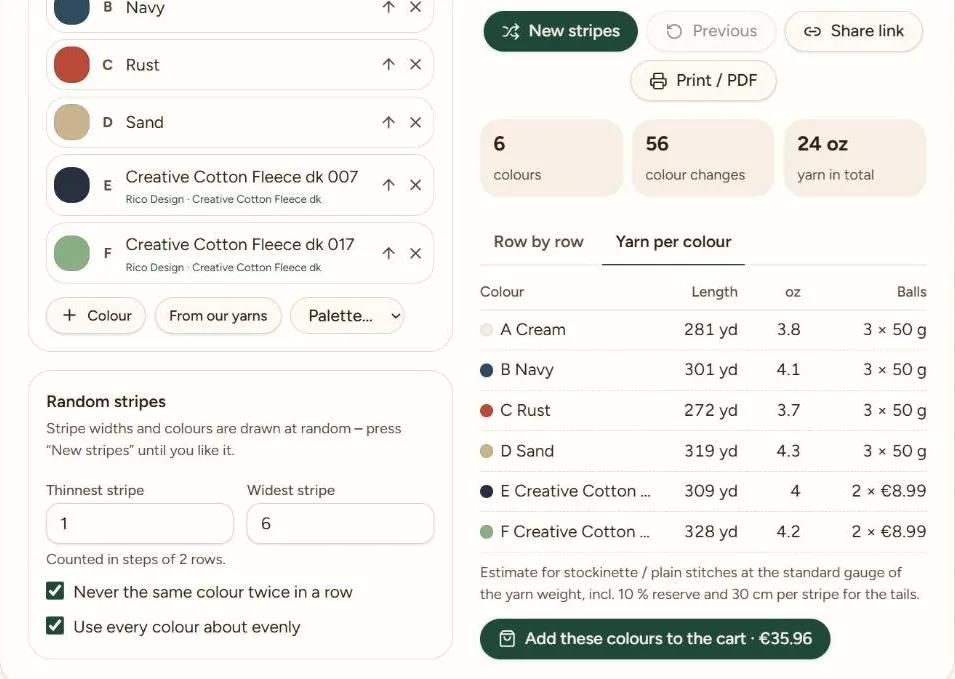
Yarn per colourHow much of each colour you need – with our yarns straight into the cart.

How to use the stripe generator

Choose a kind of stripes, your project and the yarn weight. The generator works out how many rows your piece has and fills exactly that with stripes – nothing left over at the end.

Pick up to eight colours: type your own, choose a palette or take real colours from our yarns. In random mode press “New stripes” until you like the look; “Previous” brings the last one back.

Tips for neat stripes

In flat knitting use stripes of 2, 4 or 6 rows: every colour change is then on the same side and the yarns can be carried up the edge – far fewer ends to weave in.

In the round the change of colour makes a small step where the round begins. A jogless join hides it: in the second round of the new colour, lift the stitch below the first stitch onto the needle and knit both together.

In crochet, change colour in the last stitch of the row before the new stripe: pull the new colour through the last loops.

How the yarn is worked out

Each colour gets its share of the yarn by the rows it covers. The total comes from the size of the piece and the yarn's standard gauge – the same maths as our yarn calculator – plus 10 % reserve and 30 cm per stripe for the tails. If you take a colour from our shop, its real ball length decides how many balls you need.

Frequently asked questions

Are the random stripes really random?

Yes, but in a planned way: the same colour never comes twice in a row and every colour is used about evenly, so the piece looks balanced. You can switch both rules off.

Can I save my stripes?

Use “Share link”: the link holds your colours, project and stripes. Open it later or send it to someone – it shows exactly the same stripes. Nothing is stored on our side.

How many colours can I use?

Up to eight. Two to five colours usually look calmest; random stripes with six or more look lively and are great for using up leftovers.

Does it work for crochet?

Yes. Switch to Crochet and choose the stitch – single, half double or double crochet rows have very different heights, so the number of rows changes.

What is a Fibonacci stripe?

Stripe widths follow the Fibonacci numbers 1, 1, 2, 3, 5, 8, 13 – each is the sum of the two before. The steady growth looks natural and is a classic for blankets and scarves.

Find the yarn for your stripes

Cotton, merino and blends in many colours – sold-out colours stay visible, so you always know what's coming back.

Browse yarn

Do you design patterns?

Sell your patterns on Garnatelier and earn commission on the yarn sold with them.

Sell your patterns

New patterns & yarn tips

About every 2 weeks. Unsubscribe any time with one click.

Yes, I'd like to receive the Garnatelier newsletter with new patterns, yarns, tips and offers by email about every 2 weeks. I can unsubscribe at any time with one click in every email. We'll first send you an email to confirm. Privacy