
Garnatelier

Free · knitting and crochet · no sign-up

Knitting gauge calculator: stitches, rows and even increases

Work out how many stitches to cast on from your swatch, convert a pattern to your own gauge, and spread increases or decreases evenly across a row or round – with written instructions you can follow straight away.

Units
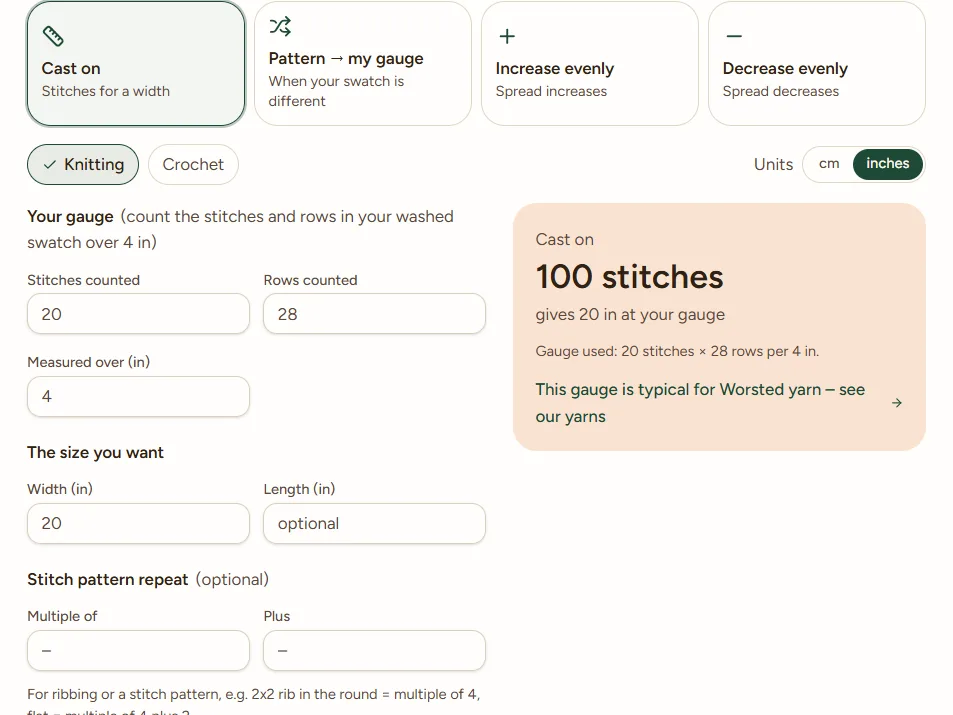
Your gauge(count the stitches and rows in your washed swatch over 4 in)
The size you want
Stitch pattern repeat(optional)

For ribbing or a stitch pattern, e.g. 2x2 rib in the round = multiple of 4, flat = multiple of 4 plus 2.

Result: 100 stitches

Cast on

100 stitches

gives 20 in at your gauge

Gauge used: 20 stitches × 28 rows per 4 in.

This gauge is typical for Worsted yarn – see our yarns

A closer look at the calculator

Four calculators in one
Four calculators in oneCast on, convert a pattern, increase or decrease evenly – knitting or crochet, cm or inches.
Written instructions
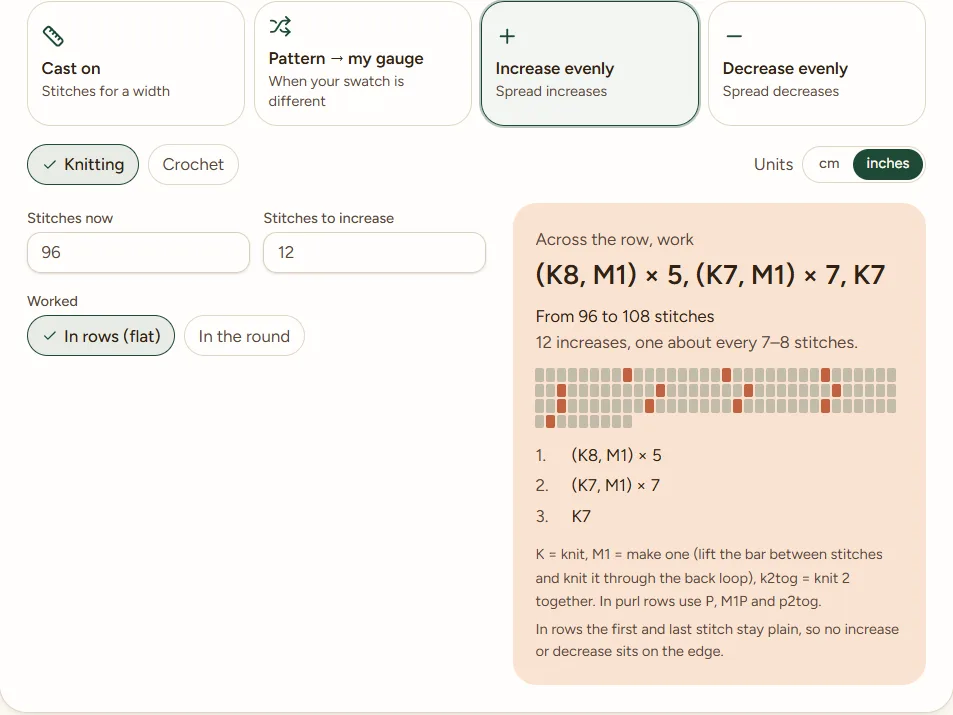
Written instructionsEven increases as a line you can follow, with a strip that shows where each one sits.
Pattern to your gauge
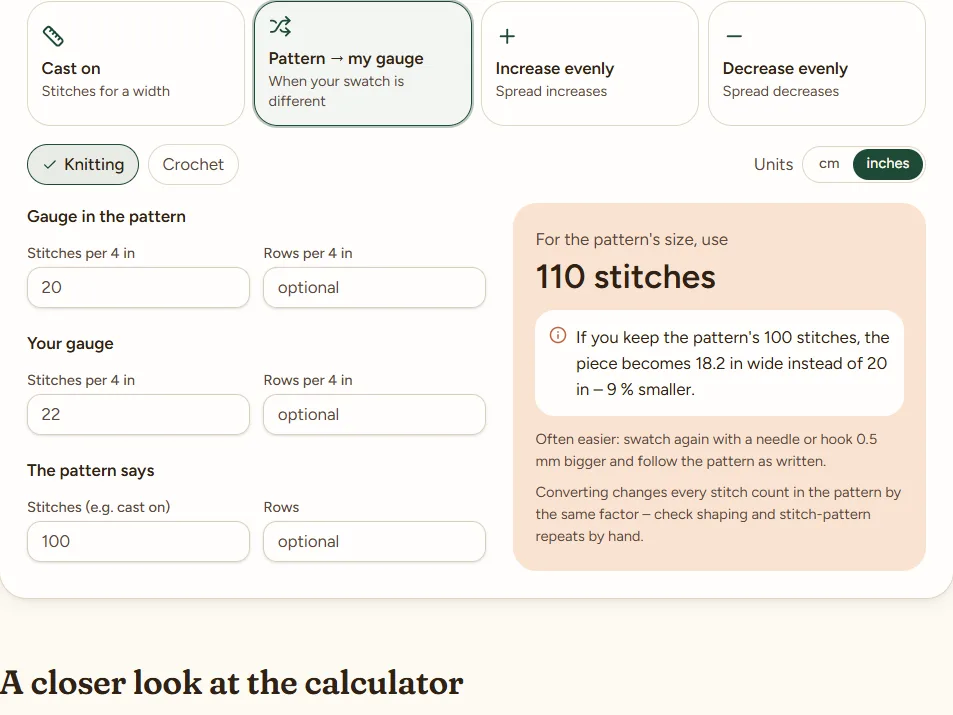
Pattern to your gaugeSee the stitch count for your gauge and how much the piece would change if you kept the pattern's numbers.

Standard gauge by yarn weight

Typical stitches per 10 cm / 4 in for each yarn weight – a good first guess before you swatch. Your own swatch always wins.

Yarn weightKnitting (stockinette)NeedleCrochet (single crochet)Hook
Lace33–401.5–2.25 mm32–421.4–2.25 mm
Fingering27–322.25–3.25 mm21–322.25–3.5 mm
Sport23–263.25–3.75 mm16–203.5–4.5 mm
DK21–243.75–4.5 mm12–174.5–5.5 mm
Worsted / Aran16–204.5–5.5 mm11–145.5–6.5 mm
Bulky12–155.5–8 mm8–116.5–9 mm
Super bulky7–118–12.75 mm7–99–15 mm
Jumbo≤ 612.75–25 mm≤ 615–25 mm

Stitches per 10 cm / 4 in. Ranges from the Craft Yarn Council's Standard Yarn Weight System.

How to measure your gauge

Knit or crochet a swatch at least 15 × 15 cm (6 × 6 in) in the stitch the pattern asks for, then wash and dry it the way you will treat the finished piece. Measure in the middle, away from the edges, and count the stitches and rows over 10 cm or 4 in.

Half stitches count: 22.5 stitches over 10 cm is a different gauge from 22. If your swatch is smaller, count over the width you have and enter it under "Measured over" – the calculator scales it.

How many stitches to cast on

Stitches = width × stitches per 10 cm ÷ 10. A 50 cm wide piece at 22 stitches per 10 cm needs 110 stitches. For ribbing or a stitch pattern the count must fit the repeat, so the calculator rounds to the nearest multiple and shows the real width you get.

For hats and socks, plan negative ease: knit the circumference about 10 % smaller than the head or foot so it fits snugly.

Spreading increases and decreases evenly

Divide the stitches into as many equal parts as you have increases (in the round) or one more (in rows), then work one increase between the parts. When the stitches don't divide evenly, some parts are one stitch longer – nobody will see the difference.

Decreases each use two stitches, so a row can lose at most half its stitches. In crochet the same rule applies: 2 sc in one stitch to increase, sc2tog to decrease.

Questions

What is gauge in knitting?

Gauge (tension) is how many stitches and rows fit into 10 cm or 4 in. Patterns give the gauge they were written for – if yours is different, the piece comes out bigger or smaller.

How do I calculate how many stitches to cast on?

Multiply the width by your stitches per 10 cm and divide by 10. With 22 stitches per 10 cm, a 50 cm piece needs 110 stitches. The calculator also rounds to your stitch-pattern repeat.

My gauge doesn't match the pattern – what now?

First try a different needle or hook size: more stitches than the pattern means go up 0.5 mm, fewer means go down. If you like your fabric as it is, convert the pattern's stitch counts with the "Pattern → my gauge" tab.

How do I increase evenly across a row?

Enter the stitches you have and how many to add. You get a line like "(K6, M1) × 5, (K5, M1) × 3, K5" that keeps the edges plain. In the round the last increase sits at the end of the round.

Is this also for crochet?

Yes. Switch to Crochet: increases become 2 single crochet in one stitch and decreases sc2tog. Gauge and cast-on work the same way.

Is the calculator free?

Yes, completely free and without sign-up. Everything is worked out in your browser; nothing you type is stored.

Next: how much yarn?

Our yarn calculator works out metres, grams and skeins for your project – exactly from your swatch.

Open the yarn calculator

Designing your own patterns?

Sell your knitting and crochet patterns on Garnatelier – together with the matching yarn.

Open your designer shop

New patterns & yarn tips

About every 2 weeks. Unsubscribe any time with one click.

Yes, I'd like to receive the Garnatelier newsletter with new patterns, yarns, tips and offers by email about every 2 weeks. I can unsubscribe at any time with one click in every email. We'll first send you an email to confirm. Privacy